Tuesday, October 2, 2012
Tuesday, September 4, 2012
Tuesday, August 21, 2012
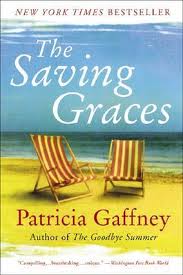
Book Club Forum #30: The Saving Graces
Book Selection Status: READ
Month: August 2012
Genre: Fiction
Book of the Month: The Saving Graces
Author: Patricia Gaffney
Question source: http://www.patriciagaffney.com/savinggraces_guide.html#
Discussion Questions
- Which Grace do you relate to most, and why? What do you define as "grace"? Where do you find it in your life?
- Why do you think the author starts and ends the story from Emma's point of view? Would you consider Emma the main character?
- When Lee is describing Isabel for the first time, she says, "Some people are born knowing things the rest of us spend our lives trying to learn." What kinds of things do you think she's talking about? Do you agree with Lee? What do you think Isabel had, or knew, that the other Graces didn't?
- The night Emma finds out that Mick Draco is married, she describes men as "speed bumps ... aggravating distractions scattered along life's otherwise pretty nice highway," and also says that good women are easier to find. Do you think she really believes this? Have you ever felt the way Emma says she does? Do you think men feel that way about women -- that, on the whole, men are the better sex -- or is this a uniquely feminine perspective?
- At one point, Rudy says about Curtis, "I tried not loving him -- just for a second; an experiment. To my horror, it worked." What does she mean by this? That her love for him isn't real? What do you think of Rudy and Curtis's relationship, over all? How did your feelings change about him over the course of the book? When he told Rudy he has leukemia, did you believe him? What do you think Rudy's dream means?
- There's a remarkably small amount of jealousy and possessiveness among the Graces. Do you think this is realistic? Have you had the same experiences with your women friends?
- When you tally it up among the four of them, the Graces experience just about every tragedy known to womankind -- cancer, infidelity, alcoholism and drug abuse, mental illness, infertility, and devastating heartbreak, to name a few. Do you think the author has woven these themes in realistically? Would you say this group of women experiences more than their share of suffering? What about joy?
- The only time the idea of romantic love between women comes up in the book is via Jenny, Henry's lesbian plumber mom. Why do you think the author wrote Jenny into the story? What purpose does she
serve? Do you think Jenny really assumes The Saving Graces is founded on the same basic ideas as the women's group/commune she belonged to in the late '70s? Is it? If so, how is it the same, and how is it
different? - Have you ever belonged to a formal group like The Saving Graces? Do you think it's difficult to form close friendships with women later in life, after school and other settings? How do you think friendships among women change as they age?
- At one point, Emma describes Isabel as her "mentor, although neither of us would ever say that out loud, and certainly we'd never use that word." Do you think that's an accurate way to describe their
relationship? - What about mothering -- is Isabel the mother figure in The Saving Graces? Or is Lee? Do you think any one member takes more than she gives, or is it all pretty equal?
- Why do you think Lee holds out for so long trying to have her own baby? Do you think she's justified in feeling so angry and desperate, especially when she has a loving husband, a good job, a nice home -- and other people have much bigger problems, like her friend Isabel, who's dying? How do you think Lee's experience with infertility affects her reactions to what's going on with Isabel?
- Isabel says "sometimes kindness is as excruciating as cruelty." What do you think she means by that?
- Why do you think the author wrote in Isabel's encounter with Sheldon Herman, the old man on the bench?
- When Isabel and Kirby sleep together for the first time, she's able to forget for a moment that she's dying -- then abruptly remembers again. Do you think that sex and death are related in any way?
- What do you think of the scene where the Graces take on Curtis? Is it realistic? Is it everybody's fantasy, in some way, to have their best friends there for them in the hardest moments? Can you really have help with these things, or do you need to face them alone?
- Do you think Emma and Mick will make it as a couple? Or were they brought together by the desire for something they couldn't have, and, now that they have it, their passion will be diminished?
- Which of the Graces do you think grew the most over the course of the book, and in what ways?
Thursday, July 12, 2012
Book Club Forum #29: The Chaperone
Book Selection Status: READ
Month: July 2012
Genre: Fiction
Book of the Month: The Chaperone
Author: Laura Moriarty
Question source: http://us.penguingroup.com/static/rguides/us/the_chaperone.html
Discussion Questions
- The Chaperone opens with Cora Carlisle waiting out a rainstorm in a car with a friend when she hears about Louise Brooks for the first time. What do we learn about Cora in this scene? What does it tell us about her and the world she lives in? Why does Laura Moriarty, the author, choose to open the novel this way? Why do you think she waits to introduce us to Brooks?
- When we first meet Louise Brooks, she seems to be the complete opposite of Cora, but the two women form an unlikely bond anyway. Are they really so dissimilar? What does Cora learn from Louise? Do you think Louise learns anything from Cora?
- When Cora arrives in New York, the city is worlds away from her life in Wichita. How much do you think Cora actually embraces New York? When she returns to Wichita, what does she bring back with her from New York? What parts of her stayed true to Wichita all along?
- The limits of acceptable behavior for women were rapidly changing in the 1920s, and both Cora Carlisle and Louise Brooks, in their own ways, push against these boundaries. Discuss the different ways the two women try to change society’s expectations for women. Is one more successful than the other? What are the values involved in each woman’s approach?
- Cora becomes frustrated with the hypocrisy of the women in her Wichita circle of friends and yet she herself chooses to keep details about her own life secret. Do you think she should be more open about her life choices? What are the risks for her if she were to be more open?
- Cora Carlisle hopes to find the secret of her past in New York City but discovers that the truth doesn’t align with either her expectations or her memory of the past. Why do you think Laura Moriarty has chosen to leave Cora’s history ambiguous? What does this tell you about Cora? How has Cora’s attitude toward her past changed by the end of The Chaperone?
- Cora narrates the events of the book from a perspective of many years later. What juxtapositions does this allow her? By placing Cora’s narration at a time of radical social change, what parallels is Moriarty making?
- Think about Louise Brooks’s behavior. How much of it would be considered scandalous today? What values has society held on to? In what ways has society changed?
Wednesday, June 20, 2012
Tuesday, May 1, 2012
Book Club Forum #27: Cutting For Stone
Book Selection Status: READ
Month: May 2012
1. What did you enjoy most about Cutting for Stone?
Month: May 2012
Genre: Fiction
Book of the Month: Cutting for Stone
Author: Abraham Verghese
Discussion Questions
2. Who was your favorite character? Why?
3. What was "missing" in the main characters' lives (Thomas, Ghosh, Hema, Genet, Marion, Shiva)? What was found?
4. What was the saddest loss in this tale?
5. What did you learn about Ethiopia's history as a country that you did not know before?
6. Did you empathize with Genet's choices? Why or why not?
7. What did you think of Thomas Stone's back story? Did it help you understand his character's actions and motivations?
8. How does Marion and Shiva's characteristics and choices as twins reflect the stories' themes about division, reconciliation, and unity?
9. Were you satisfied with the conclusion? Why or why not?
Tuesday, April 3, 2012
Book Club Forum #26: Home Front
Book Selection Status:
READ
Month: April 2012
1. Based on your interpretation can you describe the personality traits of each member of the Zarkades family?
2. What did you like most about this book? Was there a specific chapter in this book that peaked your interest? Why?
3. What circumstances aided in the deterioration of Michael and Joleen Zarkades marriage?
4. How would you rate their parenting skills?
5. How did the war affect the Zarkades family and Michael and Joleen's marriage?
6. How did this book affect your view about marriage and family in general?
7. If you were to meet these characters, what advice would you offer them?
8. How do you feel about the conclusion of this story?
Month: April 2012
Genre: Fiction
Book of the Month: Home Front
Author: Kristin Hannah
Question source: N/A
Discussion Questions:
1. Based on your interpretation can you describe the personality traits of each member of the Zarkades family?2. What did you like most about this book? Was there a specific chapter in this book that peaked your interest? Why?
3. What circumstances aided in the deterioration of Michael and Joleen Zarkades marriage?
4. How would you rate their parenting skills?
5. How did the war affect the Zarkades family and Michael and Joleen's marriage?
6. How did this book affect your view about marriage and family in general?
7. If you were to meet these characters, what advice would you offer them?
8. How do you feel about the conclusion of this story?
Subscribe to:
Posts (Atom)